
🟨 Synchronous serial-port configuration and byte I/O
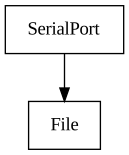
SaneCppSerialPort.h opens and configures native serial devices behind the same owned descriptor abstraction used by the File library.
Dependencies
When SerialPort fits
Use SerialPort when an application already knows the device path and needs a small, portable layer for opening a serial connection, applying the usual line settings, and exchanging bytes. The library covers baud rate, data bits, parity, stop bits, software or hardware flow control, blocking mode, handle inheritance, and exclusive opening.
It deliberately does not discover ports, monitor USB hotplug events, frame messages, buffer a protocol, or interpret the bytes. Those policies are device- and application-specific. Code that needs a list of friendly device names, automatic reconnection, modem-control lines, break signalling, or a protocol such as Modbus needs another layer around this one.
A serial port is a configured file descriptor
SC::SerialDescriptor derives from SC::FileDescriptor. Opening it first opens the native device for reading and writing, then applies SC::SerialOpenOptions::settings. If applying those line settings fails, the newly opened descriptor is closed rather than returned in a partly configured state.
The descriptor owns the native handle and is move-only through the File library's handle abstraction. Destruction or SC::FileDescriptor::close releases it; moving transfers that responsibility. The path and settings passed to SC::SerialDescriptor::open are consumed during the call and are not retained. SerialPort does not allocate an I/O buffer: reads fill caller-provided spans, writes borrow caller-provided bytes for the duration of the call, and failures are reported as SC::Result.
This representative example is compiled as part of SerialPortTest:
    SerialDescriptor serial;
    SerialOpenOptions options;
    options.settings.baudRate    = 115200;
    options.settings.dataBits    = SerialSettings::DataBits::Bits8;
    options.settings.parity      = SerialSettings::Parity::None;
    options.settings.stopBits    = SerialSettings::StopBits::One;
    options.settings.flowControl = SerialSettings::FlowControl::None;
#if SC_PLATFORM_WINDOWS
    StringView serialPath = "COM3";
#else
    StringView serialPath = "/dev/ttyUSB0";
#endif
    SC_TRY(serial.open(serialPath, options));

    SerialSettings current;
    SC_TRY(serial.getSettings(current));
    current.baudRate = 57600;
    SC_TRY(serial.setSettings(current));

    const char tx[] = {'P', 'I', 'N', 'G'};
    SC_TRY(serial.write({tx, sizeof(tx)}));

    char       rxBuffer[64] = {};
    Span<char> rxData;
    SC_TRY(serial.read({rxBuffer, sizeof(rxBuffer)}, rxData));
    // rxData is a slice of rxBuffer with the actual received bytes
The resulting stream has no message boundaries. A successful read reports the slice actually filled and may produce fewer bytes than requested; the caller must accumulate bytes according to its own framing rules. Likewise, a higher-level protocol must decide how to handle partial messages, timeouts, checksums, retries, and reconnects.
Settings describe intent, drivers decide what is possible
SC::SerialSettings defaults to 9600 baud, 8 data bits, no parity, one stop bit, and no flow control. open applies those defaults unless the caller supplies different options. SC::SerialDescriptor::getSettings reads back the settings the driver exposes, while SC::SerialDescriptor::setSettings changes an open port without reopening it.
The portable shape of the settings does not guarantee that every combination works on every adapter or operating system. POSIX builds accept only baud constants available on the target platform, and hardware flow control requires native CRTSCTS support. Windows passes the requested positive baud rate to the communications driver. Drivers can still reject unsupported data-bit, parity, stop-bit, or flow-control combinations. Treat a successful Result—and, when it matters, getSettings readback—as the capability check for the attached device.
POSIX paths must be absolute native/UTF-8 or ASCII device paths such as /dev/ttyUSB0 or /dev/tty.usbserial-*. Windows accepts COMx names and transparently retries them with the \\.\ prefix, which also allows higher-numbered COM ports. SerialPort does not choose between similarly named devices or provide stable hardware identity.
Blocking, Async, and ownership boundaries
SC::SerialOpenOptions::blocking selects the native mode used when the handle is opened. A blocking descriptor is suitable for straightforward synchronous code or a worker thread, but device and driver behavior still controls when reads return. Setting blocking to false prepares the native descriptor for asynchronous use; it does not turn SC::FileDescriptor::read or write into an event-driven API by itself.
On Windows, SerialPort installs fixed COMMTIMEOUTS: blocking reads use a 50 ms interval timeout plus a size-dependent total timeout, while non-blocking opens use the native immediate-return pattern. These values are not caller-configurable. On POSIX, raw-mode VMIN and VTIME are both zero, so framing and wait policy still belong above this layer.
For event-loop integration, open the serial descriptor as non-blocking and pass it to SC::AsyncEventLoop::associateExternallyCreatedFileDescriptor from the Async library. The descriptor continues to own the handle, so it must remain alive while requests or event-loop registrations can refer to it. SerialPort does not depend on Async; applications that only need synchronous access pay for no event-loop layer.
The inheritable option controls whether child processes may inherit the native handle. It defaults to false, which is the safer ownership boundary for most applications. On Windows, exclusive disables handle sharing. POSIX currently passes O_EXCL to the device open, which may not enforce serial-port exclusivity on the target OS or driver. Do not treat the option as a portable cross-process locking protocol.
Boundaries and tradeoffs
SerialPort is intentionally a thin specialization of File: configuration lives here, while byte reads, writes, closing, native-handle ownership, and span-based memory behavior come from SC::FileDescriptor. This keeps the library small and lets the same descriptor participate in Async, but it also means there is no serial-specific read queue, caller-configurable timeout policy, drain/flush operation, or packet API.
That boundary is a good fit when the application already has a device protocol and wants direct control over storage and lifetime. It is a poor fit when the desired abstraction is “find this USB product and maintain a reliable framed session”; enumeration, identity, reconnection, buffering, and protocol state must currently be built above the library.
For the complete API surface and option fields, see the SerialPort module.
Status
🟨 MVP The current scope is usable for byte-stream descriptors and core serial settings, with automated pseudo-terminal coverage on POSIX and an optional real com0com loopback test on Windows. Broader adapter and edge-case driver coverage is still needed.
Testing a real Windows COM pair
The windows com0com open/config/readback section of SerialPortTest can exercise a configured virtual COM pair. Set both SC_TEST_COM0COM_PORT_A and SC_TEST_COM0COM_PORT_B to COMx or \\.\COMx values. With neither variable set, the test reports a skip; a missing partner or malformed value is a configuration failure.
For example:
SC.bat build run SCTest Debug vs2022 -- --test "SerialPortTest" --test-section "windows com0com open/config/readback"
Blog
Some relevant blog posts are:
Roadmap
🟩 Usable
- Validate against more USB-to-serial adapters and edge-case drivers.
🟦 Complete Features:
- To be decided
💡 Unplanned Features:
- Port enumeration and hotplug monitoring
Statistics
LOC counts exclude comments. Library counts files physically under Libraries/SerialPort. Single File counts SaneCppSerialPort.h. Standalone counts SaneCppSerialPortStandalone.h and intentionally includes dependency payloads.
| Metric | Header | Source | Sum |
|---|---|---|---|
| Library | 230 | 634 | 864 |
| Single File | 717 | 1154 | 1871 |
| Standalone | 2364 | 3390 | 5754 |