
SaneCppAwait.h is an
experimental library providing co_await syntax on top of Async.
@warning
This library is currently MVP / Experimental. It covers useful Async workflows, but the API may still change as
the coroutine model is refined. Use it for focused experiments and examples, not as a stable public API yet.
Dependencies
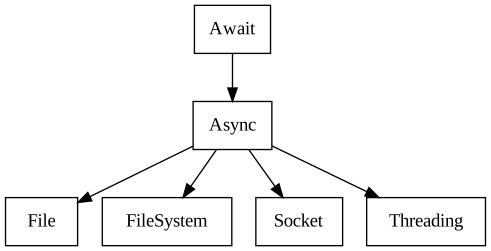
Design Intent
Await is not a replacement for AsyncEventLoop. It wraps an existing AsyncEventLoop& with AwaitEventLoop and keeps
the same lifetime expectations: sockets, buffers, requests, output objects, and tasks must remain valid while operations
are active.
The goal is to let the compiler generate the callback state machine while preserving the Sane C++ style:
- coroutine functions return
AwaitTask; - coroutine completion returns plain
Result; - extra outputs are passed through explicit caller-provided objects;
- callback-style
SC::Asynccode can coexist on the same event loop; - coroutine frame allocation is explicit through a mandatory
AwaitAllocator.
Features
| Await API | Description |
|---|---|
| AwaitEventLoop | SC::AwaitEventLoop |
| AwaitTask | SC::AwaitTask |
| AwaitAllocator | SC::AwaitAllocator |
| AwaitSleepAwaiter | SC::AwaitSleepAwaiter |
| AwaitSocketAcceptAwaiter | SC::AwaitSocketAcceptAwaiter |
| AwaitSocketConnectAwaiter | SC::AwaitSocketConnectAwaiter |
| AwaitSocketSendAwaiter | SC::AwaitSocketSendAwaiter |
| AwaitSocketSendToAwaiter | SC::AwaitSocketSendToAwaiter |
| AwaitSocketSendAllAwaiter | SC::AwaitSocketSendAllAwaiter |
| AwaitSocketReceiveAwaiter | SC::AwaitSocketReceiveAwaiter |
| AwaitSocketReceiveExactAwaiter | SC::AwaitSocketReceiveExactAwaiter |
| AwaitSocketReceiveLineAwaiter | SC::AwaitSocketReceiveLineAwaiter |
| AwaitSocketReceiveFromAwaiter | SC::AwaitSocketReceiveFromAwaiter |
| AwaitLoopWakeUp | SC::AwaitLoopWakeUp |
| AwaitLoopWakeUpAwaiter | SC::AwaitLoopWakeUpAwaiter |
| AwaitFileReadAwaiter | SC::AwaitFileReadAwaiter |
| AwaitFileReadUntilFullOrEOFAwaiter | SC::AwaitFileReadUntilFullOrEOFAwaiter |
| AwaitFileWriteAwaiter | SC::AwaitFileWriteAwaiter |
| AwaitFileSendAwaiter | SC::AwaitFileSendAwaiter |
| AwaitFilePollAwaiter | SC::AwaitFilePollAwaiter |
| AwaitFileSystemOperationAwaiter | SC::AwaitFileSystemOperationAwaiter |
| AwaitTaskGroup | SC::AwaitTaskGroup |
| AwaitTaskRegistry | SC::AwaitTaskRegistry |
| AwaitTaskGroupResultSummary | SC::AwaitTaskGroupResultSummary |
| AwaitTaskGroupWaitAllAwaiter | SC::AwaitTaskGroupWaitAllAwaiter |
| AwaitTaskGroupWaitAnyAwaiter | SC::AwaitTaskGroupWaitAnyAwaiter |
| AwaitTaskRegistryWaitAllAwaiter | SC::AwaitTaskRegistryWaitAllAwaiter |
| AwaitTaskRegistryWaitAnyAwaiter | SC::AwaitTaskRegistryWaitAnyAwaiter |
| AwaitProcessExitAwaiter | SC::AwaitProcessExitAwaiter |
| AwaitSignalAwaiter | SC::AwaitSignalAwaiter |
| AwaitTaskSpawnAwaiter | SC::AwaitTaskSpawnAwaiter |
| AwaitTaskTimeoutAwaiter | SC::AwaitTaskTimeoutAwaiter |
| AwaitLoopWorkAwaiter | SC::AwaitLoopWorkAwaiter |
Example
AwaitTask echoServer(AwaitEventLoop& await, const SocketDescriptor& serverSocket, SocketDescriptor& accepted)
{
char receiveBuffer[64] = {};
AwaitSocketReceiveResult received;
SC_CO_TRY(co_await await.accept(serverSocket, accepted));
SC_CO_TRY(co_await await.receive(accepted, {receiveBuffer, sizeof(receiveBuffer)}, received));
SC_CO_TRY(co_await await.sendAll(accepted, received.data));
co_return Result(true);
}
AwaitTask echoClient(AwaitEventLoop& await, const SocketDescriptor& client, SocketIPAddress address,
Span<char> replyBuffer, AwaitSocketReceiveResult& reply)
{
const char message[] = "niche readable await";
SC_CO_TRY(co_await await.connect(client, address));
SC_CO_TRY(co_await await.sendAll(client, {message, sizeof(message) - 1}));
SC_CO_TRY(co_await await.receive(client, replyBuffer, reply));
co_return Result(true);
}
AwaitTask echoConversation(AwaitEventLoop& await, const SocketDescriptor& serverSocket,
const SocketDescriptor& client, SocketIPAddress address,
SocketDescriptor& accepted, Span<char> replyBuffer,
AwaitSocketReceiveResult& reply)
{
AwaitTask server = echoServer(await, serverSocket, accepted);
AwaitTask clientTask = echoClient(await, client, address, replyBuffer, reply);
AwaitTask* storage[2] = {};
AwaitTaskGroup group(await, storage);
SC_CO_TRY(group.spawn(server));
SC_CO_TRY(group.spawn(clientTask));
SC_CO_TRY(co_await group.waitAll());
co_return Result(true);
}
The reply buffer is supplied by the caller because Await keeps the same stable object and buffer lifetime expectations
as Async.
Complete console examples live in:
Examples/AwaitBackgroundDigest, showing ThreadPool-backed CPU work withloopWork()and caller-owned job state.Examples/AwaitBackgroundJobs, showing detached background coroutines through fixed caller-ownedAwaitTaskRegistryslots.Examples/AwaitFirstResponse, racing caller-owned registry jobs withwaitAny()and cancelling the slower response.Examples/AwaitConfigReload, showingspawnAndWait()for a single child coroutine that loads a config file.Examples/AwaitDeadline, showing a child coroutine deadline withwaitFor()and cooperative cancellation.Examples/AwaitEcho, showing sockets, task groups, and fixed-allocator-backed tasks.Examples/AwaitDatagramPing, showing UDPsendTo()/receiveFrom()request and reply flow.Examples/AwaitTaskGroupFiles, showing Pythonasyncio.TaskGroup-style fan-out over two file reads while keeping task storage caller-owned.Examples/AwaitCallbackBridge, showing callback-styleAsyncand coroutine-styleAwaitsharing one caller-owned event loop during migration.Examples/AwaitFileCourier, showing a file copy followed byfileSend()over a socket.Examples/AwaitFilePatch, showing offsetfileWrite()followed byfileRead()with caller-owned buffers.Examples/AwaitLineProtocol, showing a tiny CRLF text protocol built withreceiveLine()andsendAll().Examples/AwaitManifestPreview, showing boundedfileReadUntilFullOrEOF()into caller-owned preview storage.Examples/AwaitProcessExitCodes, showing concurrent child-process exit waits with fixed job storage.Examples/AwaitServiceProbe, showing a small service probe with nested task groups, sockets, timeout cancellation, and allocator diagnostics.Examples/AwaitThreadWakeUp, showing another thread waking an Await coroutine throughAwaitLoopWakeUp.
Socket send helpers
send() is the direct one-shot wrapper over AsyncSocketSend: it completes when the socket reports one send
operation, which may be smaller than the caller-provided data.
sendAll() is the higher-level stream helper: it reactivates the underlying send request until all caller-provided data
has been sent. When an AwaitSocketSendResult* is provided, numBytes reports the cumulative byte count.
Single-buffer data can be sent directly:
const char message[] = "single buffer payload";
AwaitSocketSendResult sent;
SC_CO_TRY(co_await await.sendAll(socket, {message, sizeof(message) - 1}, &sent));
Scatter/gather data uses caller-owned span storage, preserving the same no-allocation shape as Async:
const char header[] = "body:";
Span<const char> buffers[] = {{header, sizeof(header) - 1}, body};
AwaitSocketSendResult sent;
SC_CO_TRY(co_await await.sendAll(socket, buffers, &sent));
Status
MVP / Experimental
Current support includes:
sleep();- socket
accept()andconnect(); - socket
send(), scatter/gathersend(),sendAll(),receive(),receiveExact(), andreceiveLine(); - datagram socket
sendTo(), scatter/gathersendTo(), andreceiveFrom(); - loop wake-up waiting with
AwaitLoopWakeUp; - file
fileRead(), offsetfileRead(),fileReadUntilFullOrEOF(),fileWrite(), offsetfileWrite(), scatter/gatherfileWrite(),fileSend(), and POSIX file readiness viafilePoll(); - serial descriptors through the existing file awaiters, because
SerialDescriptoris aFileDescriptorandAsyncmodels serial I/O withAsyncFileRead/AsyncFileWrite; - selected filesystem operations:
fsOpen(),fsClose(),fsRead(),fsWrite(),fsCopyFile(),fsCopyDirectory(),fsRename(),fsRemoveEmptyDirectory(), andfsRemoveFile(); - filesystem watching remains in FileSystemWatcher rather than direct
AwaitEventLoopawaiters, because it is a long-lived callback stream instead of a one-shot operation; - background
loopWork(); - process exit waiting with
processExit(); - one-shot signal waiting with
signal(); - task cancellation for currently suspended operations, including several socket, file readiness, wake-up, and task-group waits covered by tests;
- awaiting explicitly spawned child tasks, or starting and awaiting one with
spawnAndWait(); - structured
AwaitTaskGroupwaiting with caller-provided task pointer storage,waitAll(), andwaitAny(); - fixed-slot
AwaitTaskRegistryownership for detached/background tasks that are cleaned up explicitly; - child task timeout with
waitFor(); - mandatory explicit coroutine frame allocation through
AwaitAllocator.
Await is tested by SCAwaitTest, which is separate from SCTest because normal Await tests and examples use C++20
coroutines with standard C++ headers enabled. Coroutine frame storage is always explicit through AwaitAllocator, so
enabling Await does not add a dependency on the Memory library.
Details
AwaitEventLoop
AwaitEventLoop wraps an existing caller-owned AsyncEventLoop&. It does not create, close, or otherwise own the
underlying loop; callback-style Async requests and coroutine-style Await tasks can share the same loop as long as
their stable objects remain alive while active.
AwaitTask
AwaitAllocator
Socket receive helpers
receive() is the direct one-shot wrapper over AsyncSocketReceive: it completes when the socket reports some data,
disconnect, or an error, and the returned AwaitSocketReceiveResult::data span may be smaller than the caller buffer.
receiveExact() is the higher-level stream helper: it reactivates the underlying receive request until the caller buffer
is full. If the peer disconnects before the buffer is full, it returns an error and, when an output result is provided,
the result object describes the partial data received so far.
receiveLine() is a no-allocation line helper for simple text protocols. It reads into caller-provided storage until
\n, trims a preceding \r from the reported line span, and fails if the buffer fills before the newline arrives.
File helpers
fileRead() is the direct one-shot wrapper over AsyncFileRead: it may return fewer bytes than the caller buffer
holds.
fileReadUntilFullOrEOF() mirrors FileDescriptor::readUntilFullOrEOF() for coroutine code. It reactivates the
underlying read request until the caller buffer is full or EOF is reached, and reports the actually-read prefix through
AwaitFileReadResult::data.
fileWrite() does not need a separate fileWriteAll() helper today: AsyncFileWrite already keeps writing until the
provided single buffer or scatter/gather buffers are fully written, or returns an error.
For offset writes, prefer a single contiguous buffer in portable examples. Combining scatter/gather file writes with an
explicit offset should be treated as backend-sensitive until the underlying AsyncFileWrite semantics are tightened.
Filesystem watcher integration
Await intentionally does not expose direct filesystem watcher awaiters yet. FileSystemWatcher already models this as
a long-lived callback stream with stable FileSystemWatcher::FolderWatcher objects and an event-loop runner
(FileSystemWatcherAsyncT<AsyncEventLoop>). That shape is closer to an async iterator or channel than to the one-shot
AsyncRequest wrappers currently living on AwaitEventLoop.
For now, coroutine examples should keep using callback-style FileSystemWatcher on the same underlying
AsyncEventLoop, or introduce a small caller-owned adapter outside the core AwaitEventLoop surface when a concrete
workflow needs it. If a future helper is added, it should be an explicit Await* object carrying the watcher state and
caller-provided notification storage, not another thin method on AwaitEventLoop.
A future watcher adapter should look more like a bounded event queue than a one-shot awaiter:
- the caller owns
FileSystemWatcher, eachFolderWatcher, the event storage, and any wake-up object; - producer callbacks push compact events into caller-provided slots and wake the awaiting coroutine;
- the coroutine awaits "next event" or "queue not empty" on the adapter object, not on
AwaitEventLoop; - when the queue fills, the adapter must return an explicit overflow result or set a sticky overflow flag that the consumer observes, rather than allocating or silently dropping events;
- the same shape may be reused for process output or accept loops only after a concrete example proves the bounded queue semantics are pleasant.
Helper placement
Thin convenience helpers currently live on AwaitEventLoop when they preserve the shape of one underlying Async
operation and only add a small, no-allocation loop over caller-provided storage. Examples are sendAll(),
receiveExact(), receiveLine(), and fileReadUntilFullOrEOF().
If future helpers start carrying protocol state, buffering policy, parsing rules, or multiple stable objects, they should
move into explicit Await* helper structs instead of making AwaitEventLoop a grab bag.
spawnAndWait() intentionally remains a convenience awaiter for the common "start one child and wait for it" case.
The name is a little longer than plain spawn(), but it makes the "starts then awaits" behavior visible and avoids
teaching co_await child to secretly start unowned tasks. AwaitTaskGroup is the structured API for multiple children,
result aggregation, waitAny(), or custom child cancellation policy.
Blog
Some relevant blog posts are:
Task state helpers
AwaitTask exposes explicit state queries (isValid(), isStarted(), isActive(), isCompleted(), and
isCancellationRequested()) so shutdown code can stay readable without hiding lifetime rules.
AwaitTaskGroup and AwaitTaskRegistry also expose small storage/state helpers such as isEmpty(), isFull(), and
remainingCapacity(). The registry adds hasActiveTasks() and hasCompletedTasks() for shutdown loops. These helpers
are only query sugar over caller-owned storage; they do not allocate, drain, cancel, or change task ownership.
Await does not currently provide an RAII scope guard that cancels and drains tasks in a destructor. Draining can fail,
and hiding that behind destructor control flow would be surprising in exceptions-off Sane C++. Prefer explicit shutdown
code that returns Result, such as cancelAll(), await.run(), and clearCompleted().
Platform notes
Await inherits the platform shape of Async. POSIX backends can use filePoll() for ordinary file or pipe handles;
on Windows the awaiter fails fast instead of hanging because normal AsyncFileReadiness support is not currently exposed for
those handles.
Thread-pool-backed file and filesystem awaiters use AsyncFileRead, AsyncFileWrite, AsyncFileSend, or
AsyncFileSystemOperation with caller-provided ThreadPool storage. Cancellation is still cooperative: when the work is
already running on a worker thread, completion may arrive before the stop request can take effect.
Local validation for Await changes should run macOS first, then Linux, then Windows. For targeted changes, prefer the
smallest relevant SCAwaitTest section when allocator behavior changes. Windows changes
should include focused SCAwaitTest Debug and Release runs before committing when the touched awaiter has
platform-specific behavior.
Serial descriptors
Await does not currently add separate serial-port awaiter names. SerialDescriptor inherits from FileDescriptor, and
the lower-level Async tests exercise serial I/O through AsyncFileRead and AsyncFileWrite; the coroutine layer keeps
that shape by using fileRead() / fileWrite() with a SerialDescriptor after it has been associated with the
underlying AsyncEventLoop.
This keeps the surface area small and preserves the plain-Result rule: if a future dedicated serial helper is added, it
should still return Result and write any extra output into an explicit caller-owned result object.
Stability Criteria
Before Await should move from MVP / Experimental to a stable status, the remaining design forks should be resolved:
- lifecycle hardening: ASan-covered teardown tests for thread-pool-backed operations and child-task destruction;
- optional helper APIs: whether filesystem watcher stream adapters are useful enough to add as explicit caller-owned
Await*objects.
No-stdlib coroutine support is not required for the current MVP status. Await can remain isolated in SCAwaitTest
while the API is still moving; a <coroutine> replacement and normal SCTest participation are stable-track work.
Cancellation
Cancellation is cooperative and follows the active awaiter's AsyncRequest::stop() when one exists. Cancelled awaits
return AwaitCancelledResult(), and callers can use AwaitIsCancelled(result) when cancellation needs to be
distinguished from ordinary failure while still preserving the plain Result API.
AwaitTask::cancel() is idempotent after cancellation has been requested. Cancellation is best-effort: if the suspended
operation is still active, Await asks the underlying AsyncRequest to stop and resumes the coroutine with the
cancellation result. If the operation has already completed, the normal completion result wins. Cancelling an already
completed task succeeds and leaves its result unchanged. Awaiter callbacks resume their continuation synchronously, so
there is no public "completed but not yet observed" cancellation window; tests cover the observable completion-wins
behavior instead.
Lifetime rules
Awaiters keep the same stable-object rules as Async: sockets, file descriptors, buffers, result objects, wake-up
objects, and child tasks must stay alive while the operation is active.
Destroying an active AwaitTask remains an assert-release programming error rather than a recoverable runtime result.
Use AwaitTask::isActive() or registry helpers such as hasActiveTasks() in shutdown code when a diagnostic check is
needed before storage goes out of scope.
When a completed child task is destroyed while an Async callback is still unwinding, AwaitEventLoop defers the
actual coroutine frame destruction until run(), runOnce(), or runNoWait() returns. This keeps any embedded
AsyncRequest alive until the lower-level event loop has finished its teardown work, without adding dynamic allocation.
Result objects may contain spans into caller-provided buffers. For example, AwaitSocketReceiveResult::data and
AwaitFileReadResult::data point into the receive/read buffer passed to the awaiter. Keep those buffers alive until
after the result has been inspected or copied elsewhere.
Task groups
AwaitTaskGroup stores caller-owned task pointers in caller-provided storage. Its default cancellation policy is
structured: cancelling the parent task while it is suspended in waitAll() or waitAny() cancels active children before
the parent completes. AwaitTaskGroupCancelPolicy::LeaveChildrenRunning exists for advanced cases where child tasks
outlive the waiting parent.
When children are already available as caller-owned task objects, spawnAll() can reduce repeated spawn() calls
without hiding storage:
AwaitTask* children[2] = {&reader, &writer};
AwaitTaskGroup group(await, children);
SC_CO_TRY(group.spawnAll(children));
For request-backed children, keep the child AwaitTask objects in caller-owned storage that outlives the parent
coroutine suspension. This mirrors Async's stable request-object rule: the coroutine frame owns the active awaiter,
so the task object should not be a short-lived temporary when the event loop may still be unwinding an async
completion. Examples/AwaitTaskGroupFiles keeps each child task inside a caller-owned job object.
waitAny() defaults to AwaitTaskGroupWaitAnyPolicy::CancelRemaining, so stack-owned child tasks are not left active
after the first child completes. Use LeaveRemainingRunning only when pending children have an explicitly managed
lifetime.
Cancellation policy names deliberately describe the observable effect rather than the call site. CancelRemaining is
the structured default for waitAny() because it cancels every still-active sibling after a winner is known.
LeaveRemainingRunning should read as an explicit escape hatch. AwaitTaskGroupCancelPolicy::CancelChildren applies
when the parent task itself is cancelled while suspended in a group wait; the alternative,
LeaveChildrenRunning, is only for owners that can prove child storage outlives the parent.
After waitAll() returns, collectResults() can copy each child Result into caller-provided storage and optionally
fill AwaitTaskGroupResultSummary with counts plus the first failed task. This keeps aggregation no-allocation and
still follows Sane C++'s plain-Result style.
If the caller only needs counts and first-failure metadata, summarizeResults() fills an
AwaitTaskGroupResultSummary& without requiring a result span.
This is intentionally close to Python asyncio.TaskGroup at the control-flow level: spawn related children, wait for
the group, and cancel siblings on structured failure paths. Examples/AwaitServiceProbe shows this with an outer group
that runs a network exchange and a bounded maintenance check, while the network exchange owns an inner server/client
group. The Sane C++ difference is visible storage: the task objects, task-pointer arrays, result arrays, buffers, and
allocator backing store are all caller-owned so lifetime and memory use remain auditable.
Detached tasks
The preferred model remains structured: keep child AwaitTask objects in caller-owned storage and wait through
AwaitTaskGroup or spawnAndWait(). When a workflow really needs detached/background ownership,
AwaitTaskRegistry provides the no-allocation shape: fixed caller-provided task slots, explicit spawn() into the
first free slot, waitAll() to drain currently registered tasks, waitAny() to wait for the first completed slot,
cancelAll() during shutdown, and clearCompleted() for cleanup and optional result aggregation.
Like AwaitTaskGroup::waitAny(), registry waitAny() defaults to cancelling the remaining active tasks after the
winner is known. Pass AwaitTaskRegistryWaitAnyPolicy::LeaveRemainingRunning only when the registry storage is a true
background lifetime owner and shutdown will later call cancelAll() or drain the active tasks.
AwaitTaskRegistry owns only task bookkeeping. It does not allocate, create coroutine frames, or hide lifetime
management. Coroutine frames come from the AwaitAllocator bound to the task's AwaitEventLoop, and active registry
tasks must be cancelled or drained before the registry storage is destroyed.
Recommended shutdown for a registry is explicit and repeatable:
SC_TRY(registry.cancelAll());
SC_TRY(await.run());
AwaitTaskGroupResultSummary summary;
registry.clearCompleted(&summary);
Calling cancelAll() on an empty or already-cancelled registry is valid. Calling clearCompleted() repeatedly is also
valid; it only releases completed slots. If a registry uses waitAny(LeaveRemainingRunning), the owner must still call
cancelAll() or otherwise drain the remaining active tasks before destroying the registry storage.
Memory allocation
AwaitAllocator is mandatory: every AwaitEventLoop receives an already opened allocator, and coroutine frame
allocation fails cleanly if no AwaitEventLoop& can be discovered from the coroutine parameters. There is no hidden
standard allocation fallback.
The default and recommended mode is fixed caller-owned storage through createFixed(Span<char>). This preserves the
Sane C++ no-hidden-allocation rule while still allowing coroutine frames to be allocated and released individually.
Explicit opt-in modes exist for integration and experiments. They are not the default Sane path and should be visible at the call site:
createVirtual()reserves virtual address space and commits pages lazily untilclose(); use it only when a workflow has a deliberately large or platform-tuned reservation budget;createMalloc()uses onemalloc()/free()pair per allocation;createPolymorphic()delegates to a caller-providedAwaitAllocatorInterfacewithout depending on the Memory library.
All modes expose the same diagnostics through AwaitAllocatorStatistics: allocation/release counts, requested
allocated/released bytes, bytes in use, peak bytes in use, largest successful allocation requested, failed allocation
count, and failed allocation sizes.
When sizing fixed storage, start from the smallest realistic workflow, run it once, inspect peakUsed() or
statistics().peakBytesInUse, and compare it with largestAllocationSize() to understand the biggest single coroutine
frame or allocator request observed. Then add headroom for the maximum number of concurrently active coroutine frames. A
task that has completed but whose AwaitTask object is still alive may keep its frame allocated until that task object
is destroyed or cleared from a registry.
The current examples intentionally use fixed storage in the 8-20 KiB range rather than a large catch-all arena. The socket-oriented examples print peak/largest/capacity diagnostics so those sizes can be revisited as coroutine frame layout changes across compilers.
char allocatorStorage[16 * 1024] = {};
AwaitAllocator allocator;
SC_TRY(allocator.createFixed(allocatorStorage));
AwaitEventLoop await(async, allocator);
// Run the workflow...
const AwaitAllocatorStatistics stats = allocator.statistics();
if (stats.numAllocationFailures != 0)
{
return Result::Error("Await allocator storage is too small");
}
// stats.largestRequestedAllocationSize shows the largest successful frame/allocation request.
Fixed storage should be sized intentionally per workflow. Prefer using diagnostics to tune the storage over switching to
createMalloc() or createVirtual() just to hide a missing sizing decision.
Exceptions
Await does not use exceptions for control flow. The C++20 test, examples, and coroutine-shim probe intentionally keep
CompileFlags::enableExceptions disabled, so macOS, Linux, and Windows validation covers the exception-disabled path.
AwaitTask::Promise::unhandled_exception() remains present because the C++ coroutine promise interface requires it when
compiling coroutine promise types.
Strict no-stdlib coroutine status
The default/recommended path uses the standard C++ <coroutine> header. A strict SC_INCLUDE_STD_CPP=0 path now exists
behind the explicit SC_AWAIT_ENABLE_NO_STDLIB_COROUTINE=1 opt-in macro. In that mode
Libraries/Await/Internal/AwaitCoroutine.h provides the minimal compiler-facing std::coroutine_traits,
std::coroutine_handle, std::suspend_always, and std::suspend_never names used by Await, backed by compiler
coroutine builtins instead of standard-library headers.
This shim is intentionally narrow and is covered by the isolated SCAwaitCoroutineShimTest target, not by normal Await
examples yet. It proves that a tiny coroutine task can compile and run with standard C++ headers disabled and exceptions
disabled on macOS, Linux, and Windows. Full SCTest participation remains Stable-track work: the shim should mature
against real AwaitTask usage and single-file-library generation before the main Await test moves out of
SCAwaitTest.
Roadmap
MVP Follow-ups:
- Add only the next
Asyncoperations that have concrete examples or migration pressure. - Add ASan-focused teardown coverage for thread-pool-backed awaiters and child-task destruction.
- Decide whether filesystem watcher integration should become an explicit stream/channel-style adapter.
- Continue tightening coroutine allocation portability, especially around member coroutine allocation discovery.
- Grow the no-stdlib coroutine shim from isolated probe coverage toward full Await coverage before moving
AwaitintoSCTest.
Statistics
| Type | Lines Of Code | Comments | Sum |
|---|---|---|---|
| Headers | 1186 | 361 | 1547 |
| Sources | 3225 | 545 | 3770 |
| Sum | 4411 | 906 | 5317 |