
🟨 Compile source-delivered C++ extensions and reload them inside a running process
Plugin is for applications that want a short edit–compile–reload loop without introducing a separate build-system invocation for every extension. It discovers C++ source plugins, invokes an installed compiler and linker, loads the resulting dynamic library into the host process, and coordinates reloads across declared plugin dependencies.
That makes it a plausible fit for developer-facing desktop tools, live UI iteration, and applications whose extensions can deliberately share the host's C++ ABI. It is not a general-purpose package format or a security boundary. Plugins run native code in the host process, and a bad pointer, an ABI mismatch, or incomplete shutdown can crash the application.
SaneCppPlugin.h is the amalgamated distribution.
Dependencies
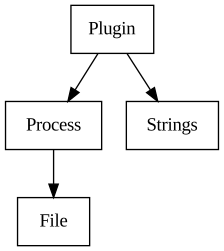
The model: source tree to live instance
A plugin is a directory containing one or more .cpp files. One file carries a comment block between SC_BEGIN_PLUGIN and SC_END_PLUGIN; the scanner derives the plugin identifier from the directory name and parses human-readable metadata, build options, and other plugin identifiers it depends on.
The host then drives four distinct stages:
PluginScannerwalks the source tree and writesPluginDefinitionobjects into caller-provided storage.PluginCompilerandPluginSysrootdescribe the compiler, include paths, system headers, and libraries. Compilation produces object files beside the plugin sources; linking produces a platform dynamic library.PluginRegistryowns neither an unbounded plugin list nor a scheduler. The host supplies aSpan<PluginDynamicLibrary>, installs scanned definitions, and explicitly asks to load or reload an identifier.PluginDynamicLibraryholds the native library handle, plugin instance, reload count, and last compiler/linker error. Optional typed contracts are obtained withqueryInterface.
Loading a plugin recursively loads its declared dependencies. Unloading does the reverse: the registry first unloads plugins that depend on the requested one. This ordering is necessary because all instances and interfaces are ordinary in-process C++ objects, not isolated handles.
A representative host loop
The following SCTest-backed example shows the complete shape: discover definitions, configure the toolchain, provide bounded registry storage, watch the source directory, and reload affected plugins. The production SCExample expands the same idea with error display and state serialization across reloads.
#include "Libraries/Async/Async.h"
#include "Libraries/FileSystemWatcher/FileSystemWatcher.h"

namespace SC
{
//-----------------------------------------------------------------------------
// IPluginContract.h
//-----------------------------------------------------------------------------
// CLIENT - HOST Contract (Interface)
struct IPluginContract
{
    static constexpr auto InterfaceHash = PluginHash("IPluginContract");

    Function<void(void)> onDraw;
};

//-----------------------------------------------------------------------------
// PluginClient.cpp
//-----------------------------------------------------------------------------
// CLIENT Plugin (binds to contract functions)
struct PluginClient : public IPluginContract
{
    PluginClient()
    {
        IPluginContract::onDraw = []()
        {
            // Draw stuff...
        };
    }

    // Called when plugin is init
    bool init() { return true; }

    // Called when plugin is closed
    bool close() { return true; }
};
SC_PLUGIN_DEFINE(PluginClient);
SC_PLUGIN_EXPORT_INTERFACES(PluginClient, IPluginContract);

//-----------------------------------------------------------------------------
// PluginHost.cpp
//-----------------------------------------------------------------------------
// Plugin HOST (loads plugin, obtains interface and calls functions)
struct PluginHost
{
    // Fill directories before calling create
    StringPath executablePath;       // Where executable lives
    StringPath libraryRootDirectory; // Where Sane C++ Libraries live
    StringPath someLibraryDirectory; // Where 3rd party-lib headers live
    StringPath pluginsPath;          // Where Plugins live

    PluginRegistry registry;

    Result create(AsyncEventLoop& loop)
    {
        eventLoop = &loop;

        // Setup Compiler
        SC_TRY(PluginCompiler::findBestCompiler(compiler));
        SC_TRY(PluginSysroot::findBestSysroot(compiler.type, sysroot));

        // Add includes used by plugins...
        SC_TRY(compiler.includePaths.push_back(libraryRootDirectory));
        SC_TRY(compiler.includePaths.push_back(someLibraryDirectory));

        // Setup File System Watcher
        fileSystemWatcherRunner.init(*eventLoop);
        SC_TRY(fileSystemWatcher.init(fileSystemWatcherRunner));
        watcher.notifyCallback.bind<PluginHost, &PluginHost::onFileChanged>(*this);
        SC_TRY(fileSystemWatcher.watch(watcher, pluginsPath.view()));
        return Result(true);
    }

    Result close()
    {
        SC_TRY(fileSystemWatcher.close());
        eventLoop = nullptr;
        return Result(true);
    }

    Result syncRegistry()
    {
        // Max 16 definitions, but you can use heap allocation if you need an arbitrary limit
        PluginDefinition       definitions[16];
        Span<PluginDefinition> definitionsSpan;
        Buffer                 fileStorage;
        SC_TRY(PluginScanner::scanDirectory(pluginsPath.view(), definitions, fileStorage, definitionsSpan))
        SC_TRY(registry.replaceDefinitions(move(definitionsSpan)));
        return Result(true);
    }

    // Call this to load a plugin with a given identifier
    Result load(StringView identifier)
    {
        // Force reload of plugin if already loaded
        SC_TRY(registry.loadPlugin(identifier, compiler, sysroot, executablePath.view(),
                                   PluginRegistry::LoadMode::Reload));

        // Obtain contract
        const PluginDynamicLibrary* plugin = registry.findPlugin(identifier);
        SC_TRY(plugin->queryInterface(contract));
        return Result(true);
    }

    void draw()
    {
        if (contract)
        {
            contract->onDraw();
        }
    }

  private:
    AsyncEventLoop* eventLoop;
    PluginCompiler  compiler;
    PluginSysroot   sysroot;

    IPluginContract* contract = nullptr;

    FileSystemWatcher fileSystemWatcher;

    FileSystemWatcher::FolderWatcher watcher;
    FileSystemWatcherAsync           fileSystemWatcherRunner;

    void onFileChanged(const FileSystemWatcher::Notification& notification)
    {
        auto reload = [this](const PluginIdentifier& plugin) { (void)load(plugin.view()); };
        registry.getPluginsToReloadBecauseOf(notification.relativePath, Time::Milliseconds(500), reload);
    }
};
} // namespace SC
The example is intentionally explicit about policy. Plugin does not create a watcher, debounce file events, preserve application state, or decide what to do with a compiler error. FileSystemWatcher can report changes, while the host remains responsible for scheduling reloads and presenting PluginDynamicLibrary::lastErrorLog.
The plugin-side contract
SC_PLUGIN_DEFINE(MyPlugin) exports the conventional MyPluginInit and MyPluginClose entry points. Initialization allocates one plugin instance and calls its init() method; shutdown calls close() and deletes it. SC_PLUGIN_EXPORT_INTERFACES optionally exports a query function that maps compile-time PluginHash values to base-class interfaces.
The interface is a C++ ABI contract despite the C entry points used to find it. Host and plugin must agree on compiler ABI, data layout, compile definitions, and the exact interface header. queryInterface returns a pointer into the plugin instance; it becomes invalid before or during unload. Do not cache that pointer across a reload.
The test plugins under Tests/Libraries/Plugin/PluginTestDirectory are the smallest concrete examples: the child declares a dependency on the parent, implements two interface bases, and exports them with SC_PLUGIN_EXPORT_INTERFACES. The host test verifies that reloading replaces executable behavior and that unloading the parent also unloads the dependent child.
Allocation and lifetime boundaries
The library follows SC's caller-storage model for discovery and registration:
PluginScanner::scanDirectoryreceives the definition array and a growable temporary file buffer. It fails rather than silently exceeding the supplied definition capacity.- Each definition has fixed limits: 8 dependencies, 8 build options, and 10 source files; identifiers and metadata also use fixed strings. These limits are part of the current API, not merely implementation details.
PluginRegistry::initreceives storage for every registeredPluginDynamicLibrary.replaceDefinitionsfails when that capacity is insufficient.- Compilation and linking are subprocess operations. Their captured diagnostics are copied into the dynamic library's fixed 8 KiB error storage and exposed through
lastErrorLog, so long diagnostics can be truncated.
Plugin instances are the important exception to the library-wide no-allocation expectation: SC_PLUGIN_DEFINE constructs the plugin with new and destroys it with delete. In the default runtime-free build, those operators are supplied by the macro and route to SC::Memory. Any state owned by the plugin must be released by close() or its destructor before the library is unloaded. The registry must itself be closed while the host services used by plugin shutdown are still alive.
Interfaces and objects must not straddle the unload boundary. A robust reload sequence stops asynchronous work, releases callbacks and interface pointers, optionally serializes host-owned state, reloads, queries fresh interfaces, and then restores state. The SCExample HotReloadSystem demonstrates that orchestration; the Plugin library does not attempt to make arbitrary live C++ state reload-safe.
Linking against the host
By default, plugins are compiled without the C or C++ runtime and resolve functionality from the loading executable or from dependency plugins. This keeps the extension surface centered on SC libraries, but it means the host must export every SC library used by plugin code.
With SC::Build, opt in with SC::Build::Project::addExportLibraries or addExportAllLibraries. Regular executables do not export SC symbols automatically. For example, a host that exposes only Foundation, Memory, and Strings passes those three library names to addExportLibraries.
Without SC::Build, define the corresponding switches consistently for the host target, for example SC_EXPORT_LIBRARY_FOUNDATION=1, SC_EXPORT_LIBRARY_MEMORY=1, and SC_EXPORT_LIBRARY_STRINGS=1. On Linux the executable must additionally expose its symbols to the dynamic loader, normally with -rdynamic. The Build documentation covers the equivalent project configuration.
A plugin metadata block can request libc and libc++ through its Build field. PluginSysroot then supplies the system include and library paths. That is useful when an extension genuinely needs the standard runtime, but it increases the ABI surface and does not make mismatched host/plugin toolchains safe. findBestCompiler and findBestSysroot are conveniences for local developer machines, not deployment guarantees; production tooling should be prepared to configure paths explicitly and report discovery failures.
Experimental Fil-C hosts
Plugins must use the same Fil-C distribution and compatible ABI as the loading executable, not the host system compiler. PluginCompiler::findBestCompiler requires SC_FILC_PLUGIN_COMPILER; the optional SC_FILC_PLUGIN_LINKER selects a separate linker driver and otherwise defaults to that compiler. SC.sh build run supplies both from the selected Fil-C toolchain, including --toolchain filc-glibc. Hosts outside SC-Build may instead configure the public compiler and linker paths explicitly.
Fil-C compiler/linker subprocesses receive an empty LD_LIBRARY_PATH. The loading executable's instrumented library paths must not contaminate native compiler tools. Additional compiler dependencies should be supplied by a launcher that configures its own native environment.
Closing a Fil-C plugin calls its explicit close entry point and releases its instance and logical handle, but does not physically unload its module or run unload destructors. Rootless Fil-C can load replaced code; every version can remain resident, so repeated hot reload is not a bounded-memory operation. Fil-C glibc currently reuses the old module on same-path reload, so LoadMode::Reload returns PluginError::ReloadUnsupported without changing the live plugins. Compile/load/interface tests run for both distributions; same-path reload coverage is excluded only for Fil-C glibc. Static-destructor cleanup and physical module reclamation must not be assumed on either distribution.
Relationships and tradeoffs
Plugin deliberately delegates adjacent concerns:
- Process runs the compiler and linker. Plugin adds the command construction and platform dynamic-library policy.
- FileSystemWatcher detects edits. Plugin only maps a changed relative path to affected plugin identifiers, with a caller-selected time tolerance.
- Build configures which host symbols are exported. Plugin is not a replacement for building the host application.
SystemDynamicLibraryis the low-level loading mechanism. Plugin adds source discovery, compilation, lifecycle entry points, dependency ordering, and interface lookup.
Compared with a conventional binary plugin SDK, source delivery gives the host control over compilation and makes hot reload straightforward, but requires a compatible toolchain on the machine and exposes plugin source. Compared with an out-of-process or WASM extension, native in-process plugins have cheap direct calls and can reuse host types, but provide no fault containment, stable wire protocol, or sandbox.
Platform status and practical limits
🟨 MVP. The implementation targets macOS, Windows, and Linux with Clang, GCC, and MSVC-style toolchains. It includes platform-specific host linking and Windows handling for debugger-held DLL/PDB files. The repository exercises real compile, link, interface-query, reload, dependency-unload, and runtime-free standard-header cases.
The current design is most credible as a development-time hot-reload facility under control of the application team. Shipping it as an end-user extension system requires additional decisions around compiler distribution, source trust, ABI compatibility, diagnostics, versioning, and recovery from plugin faults. Precompiled closed-source plugins, cross-compiler ABI support, sandboxing, RPC isolation, and WASM hosting are not implemented features.
Further reading
- SCExample contains the fuller
HotReloadSystembuilt fromPluginandFileSystemWatcher. - Building as a library user describes manual host export switches.
- Ep.22 – Hot-Reload dear imgui
- Ep.24 – Hot-Reload C++ on iOS
- Ep.25 – C++ Serialization and Reflection (with Hot-Reload)
- June 2024 update and July 2024 update provide historical context.
Blog
Statistics
LOC counts exclude comments. Library counts files physically under Libraries/Plugin. Single File counts SaneCppPlugin.h. Standalone counts SaneCppPluginStandalone.h and intentionally includes dependency payloads.
| Metric | Header | Source | Sum |
|---|---|---|---|
| Library | 1293 | 1509 | 2802 |
| Single File | 2197 | 2228 | 4425 |
| Standalone | 5550 | 6446 | 11996 |