 Sane Coding Blog
 ☀️ Sane C++ July 26
Welcome to the July 2026 update! This month introduces Fibers and AsyncFibers, and starts a careful benchmark evaluation of cooperative scheduling, worker pools, and stackless jobs.
Fibers
The biggest new library this month is Fibers.
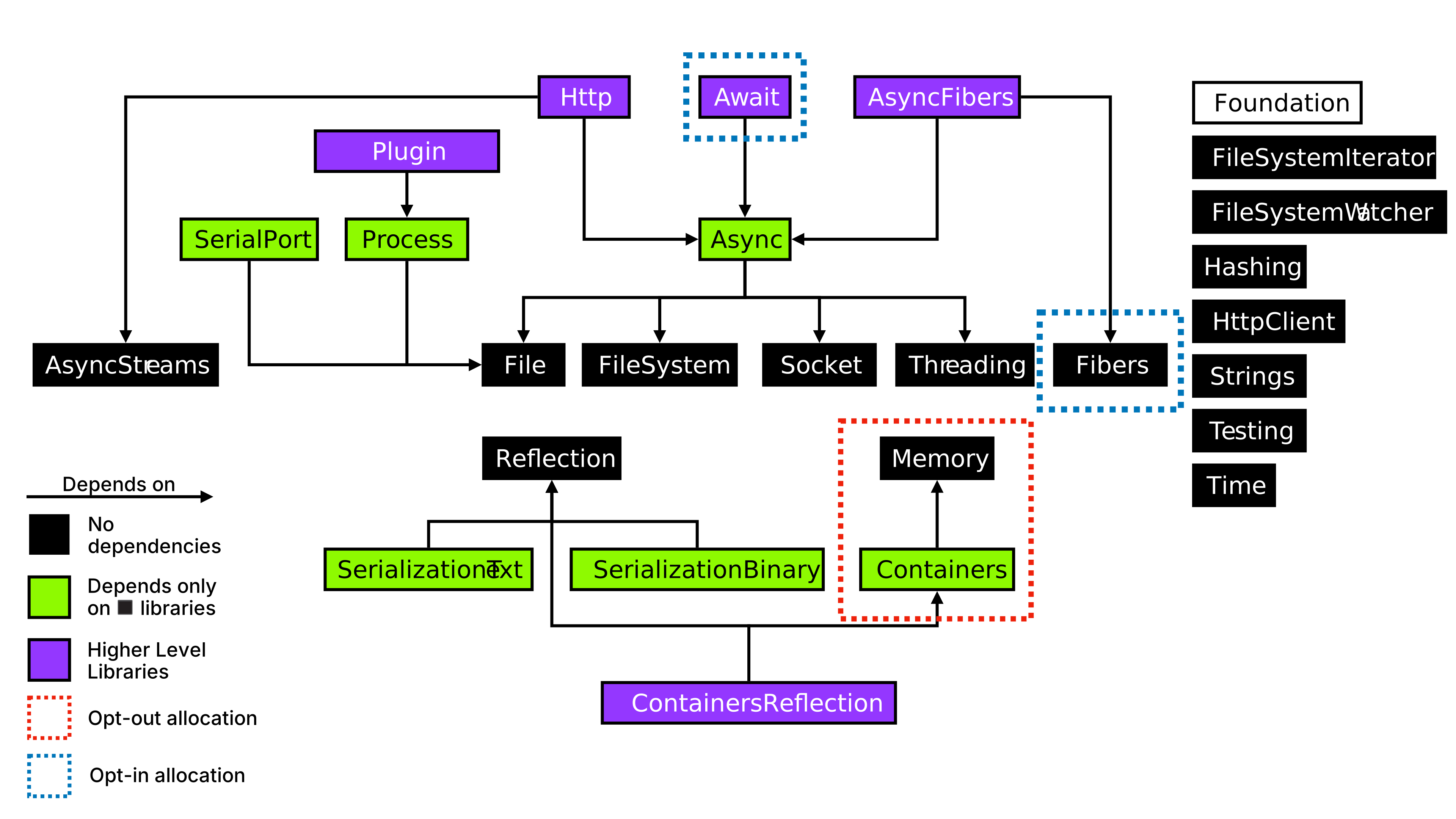
It is a stackful cooperative scheduler for code that wants synchronous-looking control flow without blocking an OS thread. A fiber owns a stack, runs ordinary C++ functions, and can suspend at an explicit yield or cooperative wait. The scheduler can then run another fiber and return to the original one later.
The design is deliberately shaped around the usual Sane C++ constraints. Tasks, stacks, pools, and worker storage are
caller-owned or backed by explicit FiberAllocator storage. Cancellation is cooperative, capacity is visible, and the
runtime does not need a hidden heap or a second event loop to make progress.
The first version already has a fair amount of surface area: scheduler, task-pool, worker-pool execution, work stealing, task groups, counters, events, semaphores, mutexes, cancellation, diagnostics, and focused tests for the context-switch and storage layers. It runs on the supported 64-bit macOS, Linux, and Windows targets, but it is still a Draft library and the API will continue to move as the scheduler is exercised by real workloads.
The architecture notes (ADR) are part of the implementation rather than an afterthought. In particular, they spell out why fiber stacks stay explicit, why logical state cannot depend on thread-local storage, and why spawn backpressure is an ordinary capacity wait instead of an implicit allocation.
Detailed list of commits:
- Fibers: Add Fibers library
- Fibers: Define stack size classes
- Fibers: Add bounded scheduler injection
- Fibers: Publish task status atomically
- Fibers: Reclaim tasks through worker registries
- Fibers: Stabilize shutdown and bridge lifetime
- Fibers: Enforce runtime call contexts
- Fibers: Retain task group results until reset
AsyncFibers
The companion library started the month under the name FibersAsync. It is now called
AsyncFibers, which describes the
direction more clearly: it is the bridge from Fibers to Async.
AsyncFibers lets a scheduled fiber wait for asynchronous sockets, files, timers, process exits, and other operations
using ordinary function calls. The bridge does not own another I/O runtime or scheduler. It joins a caller-owned
AsyncEventLoop to a caller-owned FiberScheduler, suspends the current fiber while an AsyncRequest is pending, and
wakes that fiber when the completion is ready.
That makes it useful for code that is easier to write as nested functions than as callbacks or coroutines. It also keeps the trade-offs visible: every concurrent fiber needs an explicitly sized stack, the event loop remains owner-thread affine, cross-thread commands use bounded caller-provided storage, and operation results are returned through small explicit output records.
This is a different shape from both callback-style Async and C++20 Await. AsyncFibers does not turn arbitrary
blocking calls into cooperative waits, and it does not add a second hidden loop. It is a focused adapter for applications
that already want stackful cooperative tasks.
The rename happened at the end of the month, after the implementation and architecture had settled enough that the public name could be corrected without hiding the history.
Detailed list of commits:
Benchmark evaluation is in progress
The benchmark evaluation is still in progress, but the first conservative results are encouraging.
The safest baseline so far is a quiet-machine Release run on an Apple M1 Pro, using macOS 15.7.2 and Apple Clang 17.
Across five measured runs, one million reusable stackful FiberTask executions completed at a median rate above
700,000 tasks per second. The same baseline sustained more than 7.7 million cooperative yields per second, scaled
useful CPU work by 3.7x from one to four workers, and demonstrated 100,000 simultaneously suspended fibers.
These measurements use bounded, caller-controlled storage without hidden runtime allocation. They are useful numbers, but they are measurements of a particular machine and build configuration, not a universal performance promise.
There is also a sneak peek at the work that followed. More recent optimization runs have crossed one million stackful
tasks per second, with one validated local checkpoint reaching approximately 1.46 million per second. The new
stackless FiberJob path has produced multi-million-job-per-second results, and the opt-in Skynet benchmark is making
the scheduler overhead easier to compare with an established task runtime.
The benchmark work is also useful as a design tool. It has exposed the cost of worker wake-ups, external task injection, stack reservation, and scheduler coordination much more clearly than a single end-to-end timing ever could.
Detailed list of commits:
- Fibers: Isolate scheduler throughput benchmarks
- Fibers: Stabilize micro-task benchmark samples
- Fibers: Add isolated density benchmark mode
- Fibers: Add suspended density milestones
- Fibers: Report per-worker benchmark diagnostics
- Fibers: Measure async stack high water
- Fibers: Add scale-up benchmarks
- Fibers: Add opt-in Skynet comparison
- Fibers: Benchmark concurrent external producers
Stackless jobs and scheduler work
Once the first stackful benchmarks were stable enough to guide the next experiments, the project started exploring a
second scheduling shape: stackless FiberJob records.
Stackful fibers are a good fit when a task needs to suspend through ordinary helper functions. Smaller CPU jobs do not
always need a private stack, so FiberJob keeps the job record and scheduling storage separate from FiberTask. July
added bounded job pools, job groups, worker records, work stealing, cancellation, retention rules, and a worker-pool
path with explicit storage.
The last part of the month focused on batching. Jobs can be published in contiguous batches, workers can retain their state between waves, and local publication can wake a parked peer without broadcasting to every worker. This is still active engineering, but the direction is promising: the benchmark becomes a way to test a specific scheduling policy, not just a scoreboard.
The most interesting early result came from the Skynet workload. A four-worker depth-six sample moved from roughly 137.7 ms to 70.8 ms after the local-batch wake policy was tightened, with later samples around 46-48 ms. Taskflow was around 31.8 ms in that particular comparison.
Detailed list of commits:
- Fibers: Prototype bounded stackless jobs
- Fibers: Add bounded job groups
- Fibers: Baseline pooled job lifecycle
- Fibers: Add stackless job worker pool
- Fibers: Add stackless Skynet benchmark
- Fibers: Add sustained job benchmark
- Fibers: Publish job batches transactionally
- Fibers: Batch Skynet child jobs
- Fibers: Recruit local batch workers gradually
- Fibers: Prove parked local batch wake
- Fibers: Expose Skynet idle spin policy
Documentation and other work
The new libraries also forced the documentation and examples to become more concrete.
FibersDemo now covers CPU fibers, AsyncFibers sleeps, and worker-pool I/O, while FibersBenchmark and the optional
Skynet benchmark make the performance experiments reproducible from the repository. The dependency graph copies for
both libraries are now part of the documentation inputs as well.
There was a broader documentation pass during the month: the practical guides and examples guide were rewritten, the example videos were organized, user integration sizes were explained, and the library pages received styling and content improvements.
On the HTTP side, TLS-related options were removed from the lower-level HTTP surface as the platform boundary becomes clearer.
Detailed list of commits:
- Documentation: Improve library pages
- Documentation: Rewrite practical guides
- Documentation: Rewrite examples guide
- Documentation: Explain user integration sizes
- Documentation: Feature example videos
- Documentation: Copy Fibers and FibersAsync dependency graph SVG
- Http: Remove TLS related options
See you next month!