 Sane Coding Blog
 🌫️ Sane C++ November 25
Welcome to the November 2025 update! This month, focus is bringing the long neglected Http library out of its initial Draft state!
Http
The Http library was initially put together in a hurry for the first release of Sane C++ Libraries almost two years ago. Since then, it has remained largely unchanged, a simple Draft that was just enough to demonstrate a basic asynchronous web server.
While useful, its minimal implementation and lack of comprehensive tests meant it was often fragile, breaking as other parts of the ecosystem evolved. The time has come to give Http the attention it deserves and begin the long process of elevating it to a more robust state.
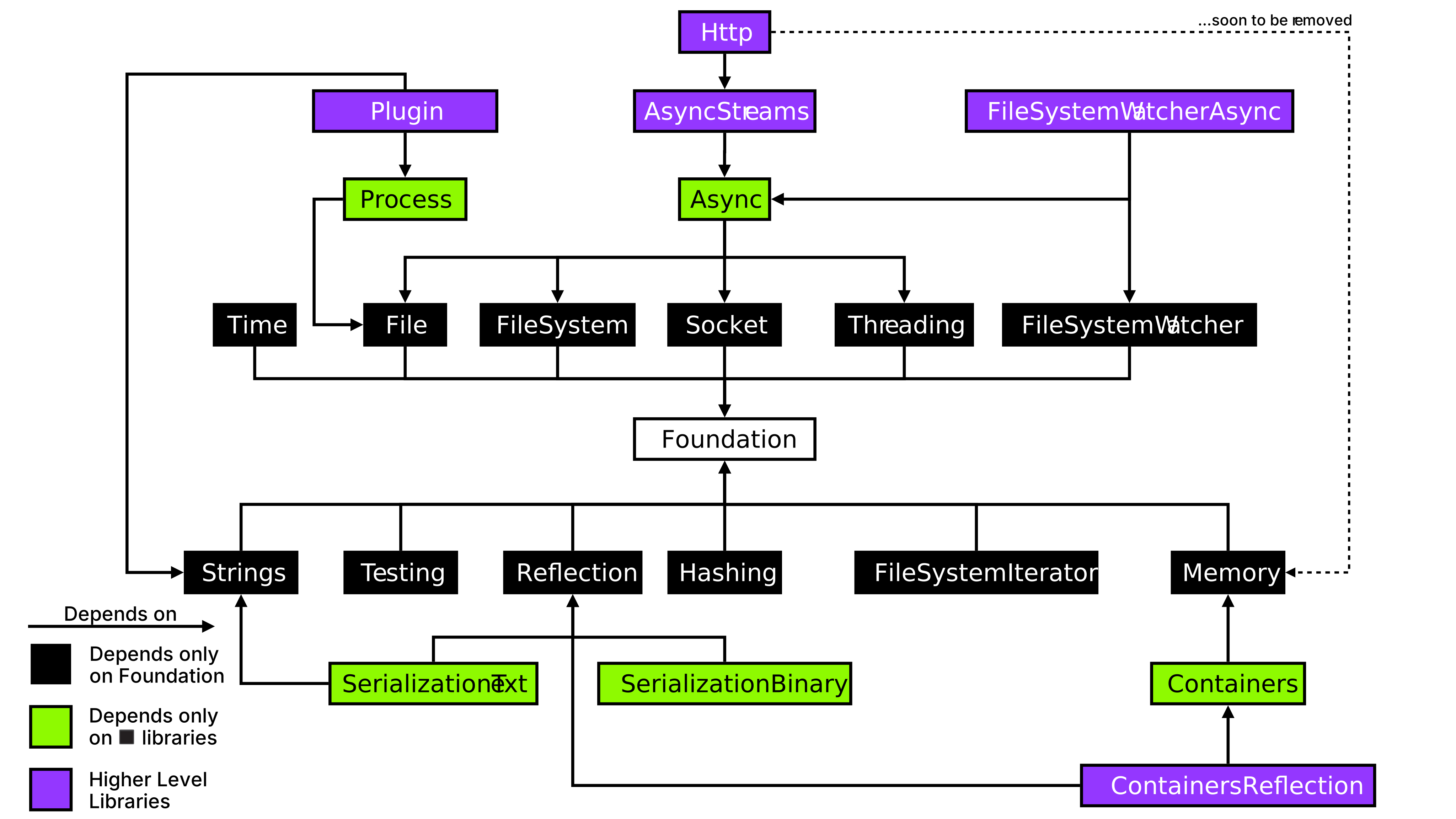
The first steps on this journey involve reducing its footprint by removing now-unnecessary dependencies on Containers and Time. Concurrently, Http is being refactored to leverage the AsyncStreams abstraction instead of dealing with raw socket operations. The next step is to remove the Memory dependency, leaving AsyncStreams as its sole dependency and solidifying its foundation.
Detailed list of commits:
- Http: Fix issues introduced when removing dependency from String
- Http: Fix using HttpServerClient across Plugin boundaries
- Http: Move HttpServer::parse to HttpRequest
- Http: Remove dependency on Containers library
- Http: Remove dependency on Time library
- Http: Split HttpAsyncServer out of HttpServer
- Http: Start integrating AsyncStreams
- Http: Stop reading data from socket stream before sending response
- Http: Write request headers to user provided region of memory
AsyncStreams
As is often the case, improvements in one library drive the evolution of another. The work on Http exposed some limitations in AsyncStreams.
Previously, AsyncStreams was strict, only allowing data from its own pre-allocated buffers. This is great for managing memory with a fixed budget, but Http needed more flexibility. It required the ability to handle data from other subsystems without forcing a copy.
To accommodate this, the buffer system in AsyncStreams is now a hybrid model. It now supports read-only buffers and IGrowableBuffer-based views, where the memory lifetime is managed by the caller. This change, along with several bug fixes to the stream's state machine, makes AsyncStreams more powerful and flexible, ready for the more complex scenarios that the evolving Http library will demand.
Detailed list of commits:
- AsyncStreams: Add read only AsyncBufferView
- AsyncStreams: Allow re-using streams after they've been stopped, ended or destroyed
- AsyncStreams: Avoid buffer leak when stopping async streams on close / finish
- AsyncStreams: Free Readable and Growable buffer slots when their refCount expires
- AsyncStreams: Remove the Destroying state
- AsyncStreams: Return true from AsyncReadableStream::push if the caller can continue pushing
- AsyncStreams: Stop socket and file requests when close or finish events happens
- AsyncStreams: Use a fixed size for AsyncPipeline transforms and sinks
- AsyncStreams: Wrap Strings / Buffers in AsyncBufferView though type erasure
- SCExample: Add option to use AsyncStreams in WebServerExample
Async
Stress-testing the new Http and AsyncStreams integration revealed some subtle edge cases in the core Async library.
For instance, on Windows, IOCP cancellations can return ERROR_NOT_FOUND if no cancellation was queued, which shouldn't be treated as a critical error by higher-level abstractions.
More critically, a re-entrancy bug was discovered. Calling the event loop's runOnce method from within a callback could cause the same callback to be invoked again before it had been fully torn down. A new internal flag, Flag_NeedsTeardown, now prevents the same completion from being incorrectly called multiple times.
Detailed list of commits:
- Async: Do not complete multiple times requests waiting for teardown
- Async: Flag most types for dll export
- Async: Handle ERROR_NOT_FOUND in IOCP cancellations using CancelIOEx
Tools
The ToolsBootstrap utility, which replaces the old bootstrap Makefiles, has received some bug fixes and feature enhancements.
This tool was largely coded with AI assistance, and in an interesting experiment, it was automatically translated from C++ to C. Why? To get even faster compilation times. While the C++ version was already quick, the C version is faster, and the translation was surprisingly low-effort. So... here it is!
Detailed list of commits:
- Tools: Compile Tools.cpp and the Tool script in parallel
- Tools: Compile with debug info enabled so that tools can be debugged
- Tools: Do not use nostdinc++ in ToolsBootstrap for older GCC
- Tools: Make bootstrap return -1 on error
- Tools: Port ToolsBootstrap to C
Build
SC::Build is steadily maturing. This month, it gained the ability to specify coverage exclusion regexes directly in the SC-Build.cpp file. Additionally, the generated Makefile targets are now smarter, automatically attempting a clean rebuild if a No rule to make target error occurs.
Detailed list of commits:
- Build: Automatically rebuild makefiles on "No rule to make target" error
- Build: De-hardcode coverage regex exclusion
Others
As with every month, there are numerous small fixes and improvements that don't need their own section but are worth mentioning.
A fix for pipe reads on Windows was added to File, and the Function template now has a user-configurable LAMBDA_SIZE to help avoid heap allocations for closures. Console gained methods for printing to stderr, and the limitations of FileSystemWatcher are now better documented thanks to a community-filed issue.
All these small changes are great indicators of the libraries maturing and hardening over time!
Detailed list of commits:
- Containers: Increase Array coverage
- File: Handle Windows ERROR_BROKEN_PIPE for synchronous reads
- FileSystemWatcher: Document file watcher limitations
- Foundation: Fix type constraints for Span
std::initializer_list constructor - Foundation: Make Function LAMBDA_SIZE user configurable
- Strings: Add Console methods to enable printing to stderr