 |
Sane C++ Libraries
C++ Platform Abstraction Libraries
|
|
Sane C++ Libraries
C++ Platform Abstraction Libraries
|
🟥 Stackful fiber I/O bridge over Async
SaneCppAsyncFibers.h lets a Fibers task wait for Async I/O using ordinary function calls. It is for code that benefits from blocking-shaped control flow but must not block the event-loop thread.
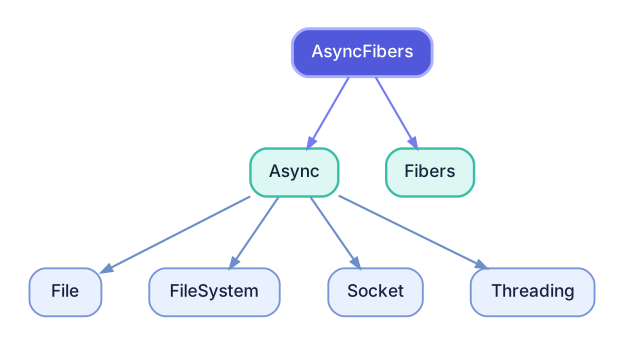
AsyncFibers does not own an I/O runtime or a scheduler. Its central object, SC::AsyncFiberIO, joins a caller-owned SC::AsyncEventLoop to a caller-owned SC::FiberScheduler. A fiber calls sleep, receive, fileRead, or another helper; the bridge starts the corresponding AsyncRequest, suspends that fiber, and makes it ready again when the request completes. Other fibers and callbacks can continue on the same loop in the meantime.
This is the useful mental model:
FiberCounter, yielding its OS thread;There is no coroutine transformation and no second hidden event loop. The price is that every call must run inside a scheduled fiber, and the application must explicitly drive both the scheduler and the event loop.
The demo's sleep example is compiled as part of the FibersDemo executable:
SC::AsyncFiberIO::runUntilComplete drives ready fibers and async completions until neither remains. The shorter runOnce, runNoWait, and runUntilIdle variants exist for embedding the bridge in a larger application loop. A successful wait does not mean that an OS thread slept: only the calling fiber was suspended.
The example also exposes the storage model. The caller supplies the event loop, scheduler, command slots, tasks, stacks, task group, and error collection. AsyncFiberIO itself borrows the event loop, scheduler, and command span; the scheduler and task group use the remaining storage.
Examples/AsyncFibersFileCopy is a complete command-line file copier rather than a sleep demonstration. It resolves two input paths, opens non-blocking descriptors, associates them with the event loop, and copies through a fixed 64 KiB buffer owned by the caller:
The loop makes the partial-operation contract visible: fileReadAt sizes its result span to the bytes received, while fileWriteAllAt repeats writes at an explicit destination offset until that span is consumed. Explicit offsets keep multi-chunk behavior independent of platform file-cursor semantics. An empty non-EOF read is rejected as no progress. The destination is opened without truncation until descriptor identities prove that a symlink or hard link does not alias the source. It is then reopened once as the nonblocking write descriptor, which also performs the truncation. The executable demonstrates the required shutdown order: finish the task, destroy the bridge, close both descriptors, then close the event loop. Run it with ./SC.sh build run AsyncFibersFileCopy -- <source> <destination>.
Using the API in this consumer exposes one intentional boundary: opening and associating descriptors is still explicit File/Async setup. AsyncFibers adapts waits on an existing descriptor; it does not hide resource creation or turn filesystem metadata operations into fiber calls.
Operations return SC::Result for success, cancellation, or an OS/backend error. Values produced by an operation use small explicit output records:
One-shot calls such as send and fileWrite may complete only part of the input. Use sendAll or fileWriteAll when the whole span is required. Likewise, fileReadExact repeats reads until the buffer is full or EOF is reached. Offset variants keep the position explicit rather than advancing the descriptor's shared position.
The bridge currently covers timers, TCP and datagram sockets, files and readiness, file-to-socket transfer, process exit, and one-shot signal waits. It is not a stream protocol, buffered reader, DNS resolver, or general blocking-call adapter; framing, buffering, retries, and higher-level protocols remain application or neighboring-library policy.
Normal operation does not allocate a coroutine frame or heap-backed request. That predictability requires several hard lifetime rules:
The request and callback state are stack-local, which is safe specifically because a suspended fiber retains its stack. Destroying or moving any referenced storage early is a correctness bug, not an operation the bridge copies around.
Capacity is similarly explicit. The application chooses the number and size of fiber stacks and, for worker-pool I/O, the number of command slots. This makes peak memory visible, but it also means exhaustion is possible and must be designed for.
SC::AsyncEventLoop remains owner-thread-affine. A fiber may nevertheless resume on a worker thread. In that case the bridge queues the request's start or stop procedure in caller-provided SC::AsyncFiberCommand storage, wakes the owner, and waits for the owner to execute it.
The source-backed worker-pool example shows the division of responsibilities:
Only the owner thread calls runOwnerUntilComplete; worker threads execute fibers. Command storage is a bounded queue, not scratch space sized only for one call. If simultaneous cross-thread starts and cancellation stops can fill it, the operation fails rather than allocating. Size it from the intended concurrency or impose producer backpressure. For a single-threaded scheduler, command storage can be omitted.
All run*, runOwner*, and cancelAll() methods are event-loop-owner calls. Every I/O operation method, including a zero-length fast path, must be called by a currently running fiber of the bridge's scheduler. The bridge rejects an operation before creating pending state or starting an AsyncRequest when that fiber context is absent; this keeps its stack-local request and callback state valid for the entire suspension.
Cancellation is cooperative. SC::FiberScheduler::requestCancel wakes an interruptible fiber wait; the bridge stops the underlying request when necessary and resumes the call with an error Result. SC::AsyncFiberIO::cancelAll asks the scheduler to cancel all active fibers. Their pending bridge operations are then stopped through the same cooperative path; callback-style requests sharing the event loop are not selected by this call.
Cancellation does not relax lifetime rules. The owner loop still has to process the stop/completion path, the fiber must resume, and its task, stack, buffers, and request dependencies must remain alive until that happens. Treat runUntilComplete/runOwnerUntilComplete, task result collection, and AsyncEventLoop::close as an ordered shutdown sequence.
AsyncFiberIO is a non-copyable, non-movable borrowed wrapper. The scheduler, event loop, command storage, operation buffers, and descriptors must outlive every operation that uses them. Destroying the wrapper with a pending operation or queued owner-thread command is a programming error diagnosed by a release assertion. Command exhaustion is a normal bounded-capacity error: it does not consume a slot permanently, and the same wrapper remains usable after the owner drains previously queued work.
Use Async directly when callbacks fit the state machine, minimizing per-operation stack memory and making every suspension point explicit. Add AsyncFibers when a workflow is easier to express as nested ordinary calls or must suspend through existing call layers. Each concurrent fiber then needs its own explicitly sized stack.
Await offers another sequential syntax over the same AsyncEventLoop. It uses C++20 co_await and allocator-backed coroutine frames; AsyncFibers uses stackful switching and caller-provided stacks. Await generally fits code designed around coroutines. AsyncFibers fits code that needs to suspend through ordinary non-coroutine helper functions, at the cost of coarser stack reservations and a draft runtime surface.
Fibers remains the scheduling and synchronization layer. It is useful without I/O, while AsyncFibers is specifically the adapter from its tasks to Async. Neither library turns arbitrary blocking system calls into cooperative waits.
🟥 Draft
The implementation has focused tests for same-thread and worker-pool waits, sockets, datagrams, files, fileSend, process exit, signals, cancellation races, and command-queue overflow on macOS, Linux, and Windows. The API is still draft: DNS and stream conveniences are absent, backend coverage follows what Async supports on each platform, and the run-loop/cancellation surface may evolve as larger applications exercise it.
For the exact operation list and result fields, see SC::AsyncFiberIO and the AsyncFibers module. Examples/FibersDemo is the smallest end-to-end example; Tests/Libraries/AsyncFibers/AsyncFibersTest.cpp contains the edge cases.
Development notes and design changes are recorded in the project updates:
LOC counts exclude comments. Library counts files physically under Libraries/AsyncFibers. Single File counts SaneCppAsyncFibers.h. Standalone counts SaneCppAsyncFibersStandalone.h and intentionally includes dependency payloads.
| Metric | Header | Source | Sum |
|---|---|---|---|
| Library | 206 | 939 | 1145 |
| Single File | 883 | 1093 | 1976 |
| Standalone | 11833 | 24739 | 36572 |
 1.12.0