 |
Sane C++ Libraries
C++ Platform Abstraction Libraries
|
|
Sane C++ Libraries
C++ Platform Abstraction Libraries
|
🟨 Generic containers (SC::Vector, SC::SmallVector, SC::Array etc.)
SaneCppContainers.h provides the small set of generic containers used by Sane C++ Libraries: contiguous sequences with selectable storage, simple vector-backed maps and sets, and a stable-address arena.
🟨 MVP
All classes defined in the library should be reasonably stable and safe to use.
Most Sane C++ libraries accept views or generic interfaces and do not require applications to adopt a particular container family. Containers is the built-in option for code that needs owning collections without introducing the STL. It is deliberately small rather than a replacement for every standard container.
Use it when you need:
You can still use externally provided string and vector classes at application boundaries. See Tests/InteropSTL/*.cpp for examples of interoperability with STL containers.
Vector<T>, Array<T, N>, and SmallVector<T, N> present the same contiguous sequence model. The important choice is where capacity comes from and what happens when it is exhausted.
| Type | Storage | When capacity is exhausted | Appropriate when |
|---|---|---|---|
Vector<T> | Heap, through a Memory allocator | Tries to grow and reports failure | The upper bound is unknown or large |
Array<T, N> | N elements inline | Reports failure; never falls back to the heap | Capacity is a hard part of the design |
SmallVector<T, N> | N elements inline, then heap | Moves to heap storage and reports allocation failure | Small collections are common but not guaranteed |
The three types are not merely similar conveniences. SmallVector<T, N> derives from Vector<T>, so code can accept a Vector<T>& while callers decide whether to provide inline capacity. When a small vector shrinks back within N, its elements move back to inline storage. This saves many short-lived allocations, but means element addresses are not stable across growth or shrinking.
Vector<T> is the basic owning sequence and the storage used by several other containers. Operations that can grow or otherwise fail return a [[nodiscard]] bool; propagate that result instead of assuming allocation succeeded.
Copy construction and assignment cannot return an error and therefore assert if their required allocation fails. For fallible paths, prefer operations such as assign, append, reserve, and push_back, whose result can be handled. The allocator can be selected explicitly, including thread-local allocation through the VectorTL and SmallVectorTL aliases declared by Containers.
Array<T, N> keeps all storage in the object. Only size() elements are alive; unused capacity is not a collection of default-constructed T objects. Its vector-like mutating operations return false when they would cross the bound.
This is the clearest choice for protocols, queues, or temporary workspaces whose maximum size is known and where an unexpected heap fallback would hide a design error.
SmallVector<T, N> keeps up to N elements inline while remaining usable through Vector<T>&. Crossing the inline capacity is allowed, so this is an allocation optimization rather than an allocation guarantee.
Choose N from a meaningful workload bound, not merely to make the type appear allocation-free. A wrong estimate is safe, but it changes allocation behavior and can invalidate pointers when storage moves.
VectorMap stores unsorted key-value pairs contiguously and finds keys with a linear scan. VectorSet uses the same idea for unique values. They work well for small collections, iteration-heavy workloads, and cases where avoiding the overhead and additional implementation surface of a hash or tree structure matters. They are a poor fit for large, lookup-heavy collections.
Both adapters accept a custom backing container. The default is Vector, while an Array or SmallVector can impose a hard bound or inline common-case storage. Comparisons are templated, allowing a stored owning key to be queried with a non-owning view when the types support comparison.
VectorSet::insert treats an already present value as success; it only returns false if inserting a new value fails.
ArenaMap<T> solves a different problem from Vector<T>: inserted objects stay at a stable address and are recovered in constant time through ArenaMapKey<T>. A key carries an index and a generation, so removing an object invalidates old handles even when that slot is later reused.
The tradeoff is explicit capacity. The arena must be resized while empty, insertion fails when all slots are occupied, and its sparse storage reserves room for the chosen maximum. This makes it suitable for registries and object graphs whose references must survive insertion and removal, not as a general-purpose dynamically growing map.
VirtualArray<T> reserves a maximum virtual address range and commits pages as the logical size grows. This keeps the base address stable without committing the full capacity up front, but it consumes virtual address space, depends on platform virtual-memory facilities, and cannot grow beyond the reservation. Use it when pointer stability and a known maximum dominate the portability and reservation costs. The Async Web Server example uses virtual arrays to reserve bounded storage for connections, stream queues, headers, and request buffers without letting later growth move them.
StrongID<Tag, Integer, InvalidValue> makes identifiers from different domains distinct C++ types while retaining a compact integer representation. The tag is intentionally empty; it prevents accidentally passing, for example, an object identifier where a connection identifier is required.
The library also contains small generic algorithms used by these containers. They operate on iterator or span-like ranges and remain separate from the choice of owning storage.
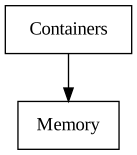
Memory provides the segment allocation machinery, global and thread-local allocators, and virtual-memory reservation used here. Containers adds typed element lifetime and collection semantics on top. Choosing Vector therefore opts into allocation through Memory; choosing Array does not.
The non-owning Span<T> and StringView types used across SC APIs are views, not Containers. Prefer those at API boundaries when the callee does not need ownership; this lets callers keep data in SC containers, STL containers, or other storage. Owning String and byte-oriented Buffer follow related storage ideas but belong to Memory; the Strings library builds text processing and formatting on top of those foundations.
Containers Reflection is a separate adapter library. Add it only when these containers must participate in Reflection or SC serialization; Containers itself does not depend on that machinery.
The contiguous containers share the Memory library's segment machinery: size and capacity metadata are stored with a contiguous element region, and element construction, movement, and destruction follow the selected storage policy. That common implementation is why Vector, Array, and SmallVector can offer closely matching operations.
The practical rules are:
Array when heap allocation must be impossible;SmallVector can allocate and move its elements in either direction across its inline boundary;ArenaMap or a suitably reserved VirtualArray when stable addresses are the actual requirement.Some relevant blog posts are:
🟩 Usable Features:
HashMap<T>Map<K, V>🟦 Complete Features:
💡 Unplanned Features:
LOC counts exclude comments. Library counts files physically under Libraries/Containers. Single File counts SaneCppContainers.h. Standalone counts SaneCppContainersStandalone.h and intentionally includes dependency payloads.
| Metric | Header | Source | Sum |
|---|---|---|---|
| Library | 1007 | 3 | 1010 |
| Single File | 1554 | 158 | 1712 |
| Standalone | 3172 | 1342 | 4514 |
 1.12.0